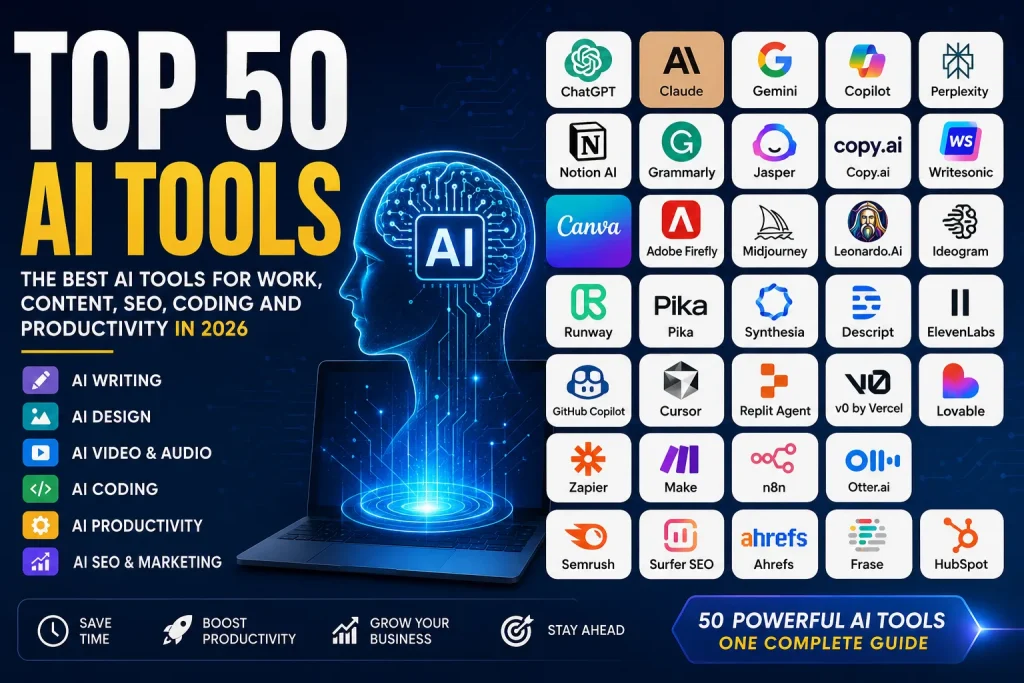
AI tools are no longer optional for modern businesses, creators, marketers, developers and entrepreneurs. They help people write faster, design better, automate repetitive tasks, analyze documents, create videos, generate code, optimize SEO content and manage daily workflows more efficiently.
But with so many platforms available, choosing the right AI tool can be difficult. Some tools are excellent for general productivity, while others are built for very specific tasks such as video editing, academic research, customer support, coding, search visibility or content optimization.
This guide covers the top 50 AI tools in 2026, organized by use case. The goal is not to say that one tool is perfect for everyone. Instead, this article helps you understand which AI tools are best for your work, your business and your daily productivity needs.
The AI tools listed below were selected based on usefulness, popularity, category strength and real workflow value. Official product pages and recent 2026 AI tool references show that the AI market now includes strong options for assistants, research, writing, design, video, audio, automation, meetings, coding and SEO.
What Are AI Tools?
AI tools are software platforms that use artificial intelligence to complete tasks that normally require human effort, creativity, analysis or decision-making. They can help with writing, image generation, video creation, coding, customer service, meeting notes, research, translation, marketing and business automation.
The best AI tools do not simply replace work. They improve workflows. A good AI tool helps users save time, reduce repetitive tasks, create better content and make faster decisions.
For example, an AI writing tool can help create blog outlines, social media captions and email drafts. An AI coding tool can suggest code, fix bugs and help build applications. An AI SEO tool can analyze search intent, keyword gaps and content structure.
Why AI Tools Matter in 2026
AI tools matter because work has become faster, more digital and more competitive. Businesses need content, websites, ads, reports, videos, customer responses and data insights faster than ever before.
In 2026, the most useful AI tools are not just simple chatbots. Many platforms now include agents, automations, document analysis, real-time search, brand voice controls, code generation, creative editing and business integrations. Tools such as ChatGPT, Claude, Gemini and Perplexity continue to be used as general AI assistants, while specialized platforms like NotebookLM, Runway, GitHub Copilot, Surfer SEO and Zapier focus on specific professional workflows.
How to Choose the Best AI Tool
Before choosing an AI tool, think about your main goal. Do you need to write better content, create images, edit videos, improve SEO, automate workflows, build apps, analyze research or manage meetings?
The best AI tool is the one that fits your daily workflow. A marketer may need Jasper, Canva, Semrush and Surfer SEO. A developer may prefer GitHub Copilot, Cursor, Replit Agent or v0. A researcher may benefit more from NotebookLM, Elicit and Consensus.
Also consider accuracy, data privacy, integrations, pricing, language support, ease of use and export options. For business use, always check whether the tool supports your team’s security and compliance needs.
Top 50 AI Tools in 2026
1. ChatGPT
ChatGPT is one of the most versatile AI tools for everyday productivity. It can help with writing, brainstorming, research, coding, planning, summarizing, translation, image generation and document analysis.
It is especially useful for businesses, students, marketers, developers and creators who need one flexible AI assistant for many different tasks. OpenAI describes ChatGPT as a tool for getting answers, exploring ideas, solving problems and improving productivity.
Best for: general productivity, writing, research, brainstorming and problem-solving.
2. Claude
Claude is a strong AI assistant for long-form writing, complex reasoning, document analysis and coding support. It is often preferred by users who need thoughtful writing, structured answers and deeper analysis.
Anthropic’s recent Claude models focus heavily on coding, advanced reasoning and agentic workflows, making Claude useful for professionals who work with long documents, spreadsheets, code and research tasks.
Best for: long documents, writing, reasoning, analysis and coding.
3. Google Gemini
Google Gemini is a powerful AI assistant for users who already work inside the Google ecosystem. It can help with writing, planning, research, learning and productivity.
Gemini is especially useful for people who use Gmail, Google Docs, Google Drive and other Google products. Google describes Gemini as a personal AI assistant for writing, planning, researching and learning.
Best for: Google Workspace users, research, productivity and everyday assistance.
4. Microsoft Copilot
Microsoft Copilot is designed for users who work inside Microsoft 365, Windows and business productivity environments. It can help with documents, emails, spreadsheets, presentations, meeting summaries and workflow support.
It is a strong option for companies already using Word, Excel, Outlook, Teams and SharePoint. For many teams, Copilot is valuable because it brings AI into tools they already use every day.
Best for: Microsoft 365 users, office productivity and business workflows.
5. Perplexity
Perplexity is an AI-powered answer engine designed for research and real-time information discovery. Unlike a traditional chatbot, it focuses heavily on search-backed answers and source-based responses.
Perplexity is useful when you need quick research, competitor checks, topic exploration, summaries and current information. The company describes it as an AI answer engine that provides accurate, trusted and real-time answers.
Best for: real-time research, source-based answers and quick topic discovery.
6. Google NotebookLM
NotebookLM is an AI research and note-taking tool that helps users analyze their own sources. It can summarize documents, create study materials and help users understand complex content.
This tool is especially useful for students, researchers, content writers and professionals who work with PDFs, notes, reports and long documents. Google describes NotebookLM as a research tool and thinking partner that analyzes sources and turns complexity into clarity.
Best for: document research, study notes, summaries and source-based analysis.
7. Elicit
Elicit is an AI research assistant for academic and scientific work. It helps users search, summarize, extract data from and chat with academic papers.
It is especially useful for literature reviews, research projects and evidence-based writing. Elicit states that it can work across more than 125 million papers and is used by researchers in academia and industry.
Best for: academic research, literature reviews and scientific papers.
8. Consensus
Consensus is an AI academic search engine built for peer-reviewed literature. It helps users find, organize and analyze scientific research faster.
This is a useful AI tool for students, researchers, healthcare professionals and writers who need evidence-based information. Consensus describes itself as an AI search engine for research and peer-reviewed literature.
Best for: scientific research, evidence-based answers and academic writing.
9. ChatPDF
ChatPDF is an AI tool that lets users upload PDF files and ask questions about them. It is useful for reading long documents, extracting key points, summarizing reports and understanding complex files.
The platform is built specifically for document analysis and includes a side-by-side document and chat interface with clickable citations inside the PDF.
Best for: PDF analysis, document summaries and research files.
10. DeepL Write
DeepL Write is an AI-powered writing assistant for improving grammar, tone, style and clarity. It is especially useful for professionals who write in multiple languages.
DeepL Write helps users sound more fluent, natural and professional while correcting spelling, grammar and punctuation.
Best for: professional writing, multilingual communication and editing.
11. Grammarly
Grammarly is one of the most popular AI writing assistants. It helps users improve grammar, tone, clarity, style and communication across apps and websites.
It is useful for emails, articles, business communication, academic writing and social media content. Grammarly describes its platform as AI writing assistance for smarter work and personalized guidance.
Best for: grammar, editing, tone improvement and business communication.
12. Jasper
Jasper is an AI writing and marketing platform built for content teams. It is useful for ads, landing pages, blogs, campaigns, brand messaging and marketing copy.
Jasper is especially valuable for teams that need brand voice consistency and campaign-level content creation. Its product material highlights copy generation, brand voice, style guides and collaboration for marketing teams.
Best for: marketing copy, brand voice and campaign content.
13. Copy.ai
Copy.ai has evolved from a simple copywriting tool into a go-to-market AI platform. It helps sales and marketing teams automate content workflows, prospecting and GTM operations.
Copy.ai positions itself as an AI-native GTM platform that connects teams, data and workflows instead of relying on many separate tools.
Best for: sales content, marketing workflows and GTM automation.
14. QuillBot
QuillBot is an AI writing tool focused on paraphrasing, grammar checking, tone analysis and fluency improvement.
It is useful for students, bloggers, professionals and non-native English speakers who want to improve sentences without rewriting everything manually. QuillBot describes its suite as AI tools for paraphrasing, grammar checking, tone analysis and fluency.
Best for: paraphrasing, rewriting and grammar improvement.
15. Writesonic
Writesonic is an AI writing platform for blog posts, ads, product descriptions, landing pages and SEO content.
It is useful for marketers and small businesses that need fast drafts for different content formats. It can help create long-form articles, short ad copy and website text.
Best for: blog writing, ad copy and website content.
16. Anyword
Anyword is an AI copywriting tool focused on performance marketing. It helps users create and test ad copy, landing page text, email campaigns and social content.
It is useful for marketers who care about conversion-focused writing and data-informed copy.
Best for: performance marketing, ads and conversion copy.
17. Rytr
Rytr is a simple AI writing assistant for short-form and long-form content. It is often used for emails, captions, descriptions, blog ideas and quick drafts.
It is a good option for users who want a lightweight writing tool without a complex workflow.
Best for: quick writing, social posts and small business content.
18. Canva Magic Studio
Canva Magic Studio brings AI design features into Canva’s visual editor. It helps users create social media graphics, presentations, ads, documents and brand assets faster.
Canva presents Magic Studio as a place where many AI-powered design tools are available together, especially for users without advanced design skills.
Best for: social media graphics, presentations, marketing visuals and simple design.
19. Adobe Firefly
Adobe Firefly is a generative AI creative platform for images, design assets and video workflows. It is especially useful for designers, marketers and businesses already using Adobe Creative Cloud.
Adobe positions Firefly as distinct because of its creative AI tools and commercially oriented approach.
Best for: image generation, creative assets and Adobe workflows.
20. Midjourney
Midjourney is a popular AI image generation platform known for highly stylized, artistic and visually impressive results.
It is useful for concept art, mood boards, campaign visuals, fantasy scenes, product inspiration and creative direction. Midjourney describes itself as an independent research lab exploring new mediums of thought and imagination.
Best for: artistic images, concept visuals and creative inspiration.
21. Leonardo.Ai
Leonardo.Ai is a generative AI platform for images, art and video. It is useful for creators, designers, game artists, marketers and brands that need creative assets with more control.
Leonardo highlights AI creative tools for creating with speed, polish and control.
Best for: creative assets, image generation, art and visual production.
22. Ideogram
Ideogram is an AI image generator known for strong text rendering inside images. This makes it useful for posters, logos, packaging, social media graphics and designs where readable text matters.
Ideogram states that it focuses on accurate text rendering, typography and layout inside generated images.
Best for: posters, logos, designs with text and marketing visuals.
23. Runway
Runway is an AI video and creative generation platform. It is useful for filmmakers, content creators, advertisers and agencies that need AI video generation and editing tools.
Runway’s official site highlights advanced video models, visual fidelity and creative control for generative video workflows.
Best for: AI video generation, creative editing and cinematic concepts.
24. Pika
Pika is an AI video generation tool for turning prompts, images and audio into video content. It is useful for short clips, social media visuals and creative experiments.
Pika’s official page highlights expressive video generation and audio-synced motion features.
Best for: short AI videos, social media clips and animated visuals.
25. Synthesia
Synthesia is an AI video platform for creating videos with AI avatars and voiceovers. It is especially useful for business training, onboarding, tutorials, internal communication and multilingual video content.
Synthesia says users can create AI-generated videos from text with avatars and voiceovers in more than 160 languages.
Best for: training videos, explainer videos and AI avatar content.
26. Descript
Descript is an AI video and podcast editing tool that lets users edit audio and video like text. It is useful for podcasters, YouTubers, course creators and marketing teams.
Descript combines recording, transcription, editing and publishing in one platform.
Best for: podcast editing, video editing, transcripts and content repurposing.
27. ElevenLabs
ElevenLabs is an AI voice and text-to-speech platform. It helps users generate lifelike speech, voiceovers, voice agents and audio content.
ElevenLabs supports many voices and languages, making it useful for videos, audiobooks, ads, podcasts, apps and customer experiences.
Best for: AI voiceovers, text-to-speech and audio content.
28. Suno
Suno is an AI music generation tool that lets users create original songs and music from prompts.
It is useful for creators, video editors, advertisers and hobbyists who need fast music ideas, background tracks or experimental songs. Suno describes itself as an AI music generator for creating original music in seconds.
Best for: AI music, background tracks and creative audio ideas.
29. Gamma
Gamma is an AI presentation maker and website builder. It helps users create presentations, documents and simple websites without design experience.
Gamma is useful for founders, marketers, teachers, consultants and teams that need polished presentations quickly.
Best for: presentations, pitch decks and AI-generated documents.
30. Beautiful.ai
Beautiful.ai is an AI presentation tool for professional slide decks. It helps users create polished presentations with smart layouts and design automation.
It is especially useful for sales teams, marketing teams, consultants and businesses that create many presentations.
Best for: business presentations, sales decks and polished slides.
31. Notion AI
Notion AI is built into the Notion workspace and helps users write, summarize, organize databases and automate knowledge work.
Recent Notion updates include custom agents and AI autofill for databases, making it useful for teams that already use Notion for notes, projects and internal documentation.
Best for: notes, project management, knowledge bases and team workflows.
32. Zapier AI
Zapier AI helps users automate workflows between apps using AI, agents and plain-language automation building.
It is useful for businesses that want to connect tools like Gmail, Slack, HubSpot, Google Sheets, Notion and thousands of other apps. Zapier describes recent automation innovation around AI orchestration, agents and Copilot.
Best for: workflow automation, app connections and business operations.
33. Make
Make is an automation platform that helps users build visual workflows between apps. With AI integrations, it can automate marketing, sales, customer service, reporting and operations.
It is useful for users who want more visual control over automations than simple trigger-action workflows.
Best for: visual automation, business workflows and app integrations.
34. n8n
n8n is an automation platform often used by technical teams, developers and operations teams. It supports custom workflows, AI steps and integrations.
It is useful for users who want more control, self-hosting options and advanced automation logic.
Best for: technical automation, AI workflows and custom integrations.
35. Otter.ai
Otter.ai is an AI meeting assistant for real-time transcription, meeting summaries, insights and action items.
It is useful for sales teams, managers, recruiters, journalists, students and anyone who attends many meetings. Otter states that its meeting agent supports real-time transcription, summaries, live chat, insights and action items.
Best for: meeting notes, transcription and action items.
36. Fathom
Fathom is an AI notetaker that captures meeting details, creates summaries, generates searchable transcripts and helps users follow up after calls.
It is useful for sales calls, client meetings, interviews and internal discussions. Fathom describes its product as a way to stay present in meetings while getting clear summaries and instant follow-ups.
Best for: meeting summaries, follow-ups and searchable transcripts.
37. Fireflies.ai
Fireflies.ai is an AI meeting assistant that transcribes, summarizes, searches and analyzes team conversations.
It is useful for teams that want to turn meetings into searchable knowledge and track important decisions across calls.
Best for: meeting transcription, team knowledge and conversation analysis.
38. GitHub Copilot
GitHub Copilot is an AI coding assistant that works inside development environments. It suggests code, helps with functions and supports developers while they write.
GitHub describes Copilot as an AI pair programmer that suggests whole lines or entire functions directly in the editor.
Best for: code suggestions, development support and software teams.
39. Cursor
Cursor is an AI code editor designed to help developers build software faster. It supports code generation, editing, debugging and natural-language development workflows.
Cursor describes itself as a way to build software with AI and increase developer productivity.
Best for: AI coding, codebase editing and developer productivity.
40. Replit Agent
Replit Agent helps users build apps with AI inside Replit. It can generate code, test its own work and help improve applications during development.
Replit highlights that its agent can test and fix code while building applications.
Best for: app building, prototyping and beginner-friendly development.
41. v0 by Vercel
v0 is an AI assistant for designing, iterating and scaling web applications. It is especially useful for generating interfaces, React components and full-stack web app ideas.
Vercel describes v0 as a collaborative AI assistant for building apps and websites for the web.
Best for: UI generation, web apps, React components and frontend workflows.
42. Lovable
Lovable is an AI app builder that lets users create apps, websites and digital products by chatting with AI.
It is useful for founders, marketers, product managers and non-technical users who want to create prototypes or web apps quickly. Lovable describes itself as a no-code and AI-powered platform for building apps and websites faster.
Best for: AI app building, prototypes and no-code product creation.
43. Bolt.new
Bolt.new is an AI app builder from StackBlitz that helps users build and scale websites and apps using natural language.
It is useful for rapid prototyping, full-stack web development and building directly in the browser. Bolt describes itself as a tool for building high-performing websites and apps using your words.
Best for: browser-based app building, prototypes and full-stack projects.
44. Windsurf
Windsurf is an AI coding assistant and AI-native IDE for developers and enterprises. It is designed to help developers stay in flow while writing, editing and understanding code.
Windsurf describes its editor as an AI-native IDE and coding assistant for developers.
Best for: AI coding workflows, enterprise development and developer flow.
45. Tabnine
Tabnine is an AI code assistant focused on accelerating software development while keeping code private, secure and compliant.
It is useful for enterprise teams that care about privacy, security and controlled AI adoption in development workflows.
Best for: secure AI coding, enterprise development and private codebases.
46. Semrush
Semrush is a marketing and SEO platform that helps users with keyword research, competitor analysis, content planning, PPC, social media and online visibility.
Semrush positions itself as a platform for growing and measuring brand visibility across AI search, SEO, PPC, social and more.
Best for: SEO, keyword research, competitor analysis and digital marketing.
47. Surfer SEO
Surfer SEO is an AI visibility and content optimization platform. It helps users optimize content for Google and AI search platforms.
Surfer describes its platform as helping brands get found in Google, ChatGPT, Perplexity, Gemini and beyond by combining content optimization, AI search tracking and topical authority.
Best for: SEO content optimization, topical authority and AI search visibility.
48. Ahrefs AI Content Helper
Ahrefs AI Content Helper helps users create content that ranks in Google and gets cited by AI platforms. It focuses on search intent, content gaps and optimization for AI discovery.
Ahrefs describes the tool as a way to match search intent, fill content gaps and optimize for ChatGPT, Perplexity and more.
Best for: SEO content improvement, content gaps and AI visibility.
49. Frase
Frase is an AI SEO content tool that helps users research topics, create briefs, optimize content and improve search performance.
It is useful for bloggers, SEO writers and content teams that need structured article briefs and search-focused content workflows. AI SEO comparison sources continue to list Frase among specialized AI-powered SEO tools.
Best for: SEO briefs, content outlines and article optimization.
50. HubSpot Breeze
HubSpot Breeze is HubSpot’s AI system for marketing, sales and customer service workflows. It can help teams with content, CRM tasks, customer insights and automation.
HubSpot’s SEO and marketing tools include AI writing, SEO strategy, content generation, social captions, meta descriptions and marketing automation features.
Best for: CRM, marketing automation, sales workflows and customer support.
Best AI Tools by Category
Best AI Tools for Writing
The best AI writing tools are ChatGPT, Claude, Grammarly, Jasper, Copy.ai, QuillBot, DeepL Write, Writesonic, Anyword and Rytr.
These tools help with blog posts, emails, ads, product descriptions, social media captions, landing pages, grammar correction and brand voice.
Best AI Tools for SEO
The best AI SEO tools are Semrush, Surfer SEO, Ahrefs AI Content Helper, Frase and HubSpot.
These tools help with keyword research, search intent, content optimization, competitor analysis, topic gaps and visibility in both Google and AI search results.
Best AI Tools for Design
The best AI design tools are Canva Magic Studio, Adobe Firefly, Midjourney, Leonardo.Ai and Ideogram.
These tools help users create images, posters, social media graphics, logos, product concepts, campaign visuals and branded content.
Best AI Tools for Video and Audio
The best AI video and audio tools are Runway, Pika, Synthesia, Descript, ElevenLabs and Suno.
These tools help with AI video generation, avatar videos, text-based editing, voiceovers, podcasts, music generation and short-form content.
Best AI Tools for Coding
The best AI coding tools are GitHub Copilot, Cursor, Replit Agent, v0 by Vercel, Lovable, Bolt.new, Windsurf and Tabnine.
These tools help developers and non-developers generate code, build apps, create interfaces, debug projects and ship prototypes faster.
Best AI Tools for Productivity and Automation
The best AI productivity tools are Notion AI, Zapier AI, Make, n8n, Otter.ai, Fathom and Fireflies.ai.
These tools help with meeting notes, workflow automation, task organization, app integrations and knowledge management.
Benefits of Using AI Tools
AI tools can save time by automating repetitive tasks. They can also improve creativity by generating ideas, drafts and visual concepts.
For businesses, AI tools can reduce operational friction. Marketing teams can produce content faster. Sales teams can personalize outreach. Developers can build prototypes faster. Managers can summarize meetings. Researchers can review large volumes of information more efficiently.
AI tools also help small businesses compete with larger companies. A small team can now create content, graphics, videos, websites, reports and automations without hiring a large department for every task.
Limitations of AI Tools
AI tools are powerful, but they are not perfect. They can make mistakes, misunderstand context, produce generic content or provide outdated information if not connected to reliable sources.
For professional use, users should always review AI-generated content before publishing. This is especially important for legal, medical, financial, technical and academic topics.
AI tools should be treated as assistants, not final decision-makers. The best results come when humans combine AI speed with human judgment, creativity and fact-checking.
How Businesses Can Use AI Tools
Businesses can use AI tools in many practical ways:
Create blog posts and SEO content.
Write product descriptions and landing pages.
Generate social media captions and ad copy.
Design marketing graphics and presentations.
Create videos, voiceovers and training materials.
Summarize meetings and extract action items.
Automate repetitive admin tasks.
Research competitors and market trends.
Build websites, apps and prototypes.
Improve customer support and CRM workflows.
The most effective businesses do not use AI randomly. They build clear workflows. For example, a marketing workflow might use Semrush for keyword research, Surfer SEO for content optimization, ChatGPT for drafts, Grammarly for editing, Canva for graphics and Zapier for automation.
FAQ
What are the best AI tools in 2026?
Some of the best AI tools in 2026 include ChatGPT, Claude, Gemini, Perplexity, NotebookLM, Grammarly, Jasper, Canva Magic Studio, Adobe Firefly, Runway, GitHub Copilot, Cursor, Zapier AI, Notion AI, Semrush and Surfer SEO.
What is the best AI tool for beginners?
ChatGPT is one of the best AI tools for beginners because it can help with many tasks, including writing, brainstorming, planning, learning, summarizing and problem-solving.
What is the best AI tool for SEO?
Semrush, Surfer SEO, Ahrefs AI Content Helper and Frase are some of the best AI tools for SEO. They help with keyword research, content optimization, search intent and ranking opportunities.
What is the best AI tool for writing?
Grammarly, Jasper, Copy.ai, ChatGPT, Claude, QuillBot and DeepL Write are strong AI writing tools. The best choice depends on whether you need grammar correction, marketing copy, long-form writing or professional editing.
What is the best AI tool for coding?
GitHub Copilot, Cursor, Replit Agent, v0 by Vercel, Windsurf and Tabnine are among the best AI coding tools. They help with code suggestions, debugging, app building, interface generation and developer productivity.
Are AI tools free?
Many AI tools offer free plans, trials or limited free usage. However, advanced features, higher limits, team collaboration and commercial use usually require paid plans.
Can AI tools replace humans?
AI tools can automate many tasks, but they do not fully replace human creativity, strategy, judgment and expertise. The best results happen when humans use AI tools to work faster and smarter.
