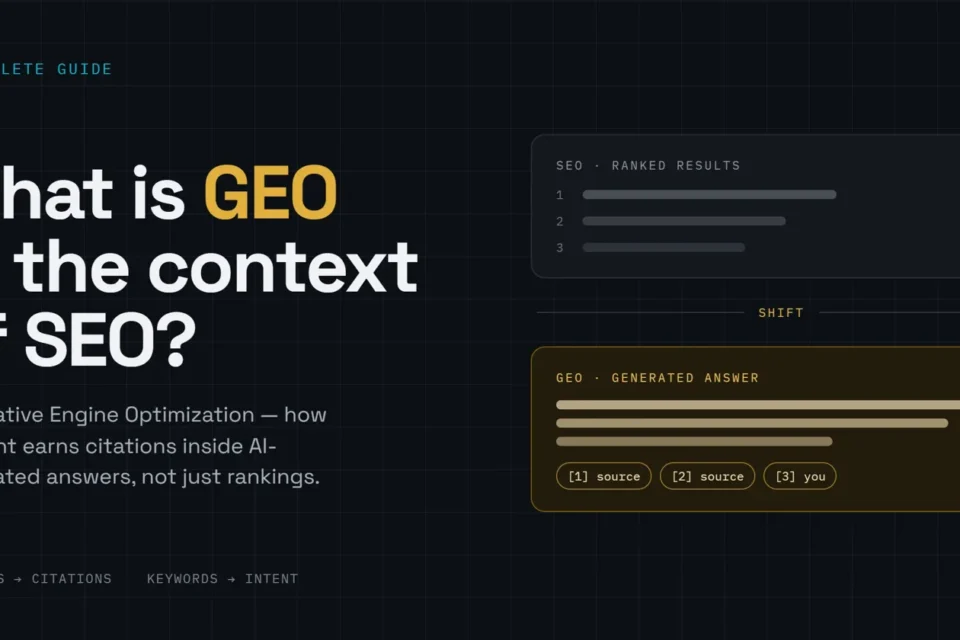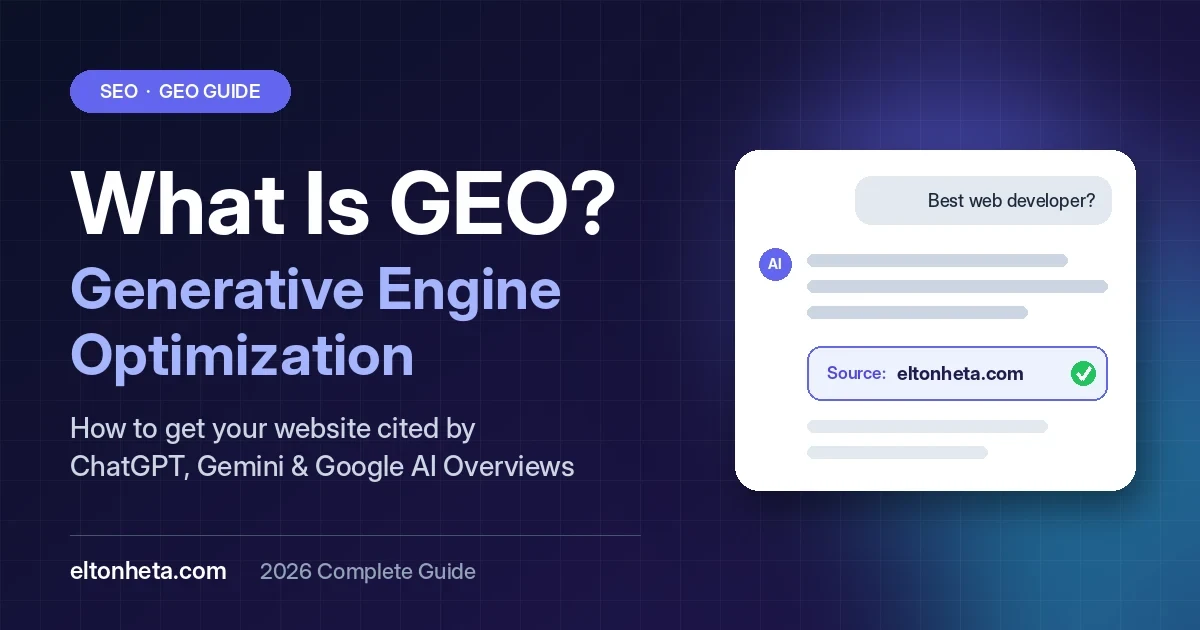
Generative Engine Optimization (GEO) is the practice of structuring your website so AI search tools – ChatGPT, Google AI Overviews, Gemini, Perplexity and Copilot – understand your content, trust it, and cite it in their answers.
Search has changed fast. According to Similarweb data reported by TechCrunch, Google’s AI Overviews went from appearing in 15% of searches to 43% in a single year. A SparkToro study covered by Search Engine Land found that 68% of Google searches ended without a click in early 2026.
In other words, ranking #1 is no longer the whole game. If the AI answer at the top of the page doesn’t mention your business, many users will never scroll down to your link. This guide explains what GEO is, how it differs from SEO, and the exact steps I use to make client websites visible in AI search.
What is GEO (Generative Engine Optimization)?
GEO means optimizing your content so it gets selected, quoted and cited by generative AI engines, not just ranked in a list of blue links. You may also see it called AEO (Answer Engine Optimization), AI SEO or LLM optimization. They all describe the same goal.
The term comes from the research paper GEO: Generative Engine Optimization by researchers from Princeton University, Georgia Tech, the Allen Institute for AI and IIT Delhi, presented at KDD 2024. They tested how different content changes affect visibility in AI answers. Their main finding: adding statistics, quotations and cited sources boosted visibility by up to 40%, while classic keyword stuffing performed poorly.
The simplest way to think about it:
- SEO gets your page into the list of results.
- GEO gets your brand into the answer.
GEO vs SEO: what’s the difference?
GEO does not replace SEO. It builds on top of it. Google says AI Overviews use the same crawling and indexing systems as regular search, so a site that isn’t indexed or trusted won’t be cited either.
| SEO | GEO | |
|---|---|---|
| Goal | Rank a page in search results | Get mentioned or cited inside AI answers |
| Where it shows | Google, Bing results pages | ChatGPT, AI Overviews, AI Mode, Gemini, Perplexity, Copilot |
| Unit of success | The page | The passage, fact or brand mention |
| Queries | Short keywords (“web developer Albania”) | Long, conversational questions (“who can build a fast WooCommerce store for a small business?”) |
| Key signals | Backlinks, keywords, technical health | Clear answers, facts and statistics, entity clarity, brand mentions across the web |
| Main metric | Rankings, clicks, CTR | Citations, share of AI answers, branded searches |
The good news: most of the work overlaps. A fast, well-structured site with genuinely useful content wins in both.
How AI search engines choose which sources to cite
Most AI search tools follow the same basic process, called retrieval-augmented generation (RAG):
- The question is expanded. The AI breaks the user’s question into several smaller search queries.
- Pages are retrieved. It pulls candidate pages from a search index (Google’s own index, Bing, or its own crawler).
- Passages are extracted. It doesn’t read your whole page. It looks for short passages that directly answer a sub-question.
- The answer is written. It combines the best passages into one answer and cites a handful of sources.
This tells you what matters. Your page must be crawlable and indexed, it must contain clear, self-contained answers, and it must look trustworthy enough to be quoted. A beautiful page that hides its answer in paragraph seven, or loads content only through JavaScript, is easy for an AI to skip.
10 GEO strategies to get your website cited by AI
1. Fix the technical foundation first
Make sure your pages are indexed in Google Search Console and Bing Webmaster Tools (ChatGPT search relies heavily on Bing). Check that robots.txt doesn’t block AI crawlers such as OAI-SearchBot, PerplexityBot and Google-Extended unless you choose to. Important content should be in the HTML, not loaded only by JavaScript.
2. Make your site fast
Slow pages get crawled less and lose users. Aim for good Core Web Vitals: LCP under 2.5 s, INP under 200 ms and CLS under 0.1.
3. Answer the question in the first two sentences
Start every article and every section with a direct answer, then explain. AI tools extract short passages, so a clear 40–60 word answer under each heading is far more likely to be quoted.
4. Use question-based headings
Write H2s and H3s the way people ask AI tools: “How much does a custom CRM cost?” instead of “Pricing”. This matches the long, conversational queries AI search runs on.
5. Add statistics, quotes and sources
This is what the Princeton GEO study found works best. Replace vague claims (“many businesses”) with numbers (“68% of Google searches”), and link to where each number comes from.
6. Show real experience (E-E-A-T)
Add an author bio, real project examples, case studies with numbers, and your own screenshots. AI engines and Google both favour content that shows first-hand experience over generic text.
7. Make your brand a clear entity
Use the same business name, description, address and services everywhere: your website, Google Business Profile, LinkedIn, Clutch, directories. Add Organization, Person and LocalBusiness schema so machines know exactly who you are and what you do.
8. Add structured data
Use FAQPage, Article, HowTo, Product and Review schema where relevant. It doesn’t guarantee citations, but it removes ambiguity about what your content is.
9. Earn mentions on other websites
AI answers often mention brands that appear across many trusted sources: industry articles, comparison lists, podcasts, local news, Reddit and forums. One good press feature can do more for GEO than ten new blog posts.
10. Keep content updated
Show a visible “last updated” date and refresh key pages regularly. AI tools prefer current information, especially for prices, tools and statistics.
How to measure GEO results
GEO is harder to track than rankings, but you can measure it with a few simple methods:
- Manual prompt tests. Make a list of 20–30 questions your customers ask. Run them monthly in ChatGPT, Gemini, Perplexity and Google AI Mode. Note whether your brand is mentioned or cited.
- AI referral traffic. In Google Analytics 4, create a segment for referrals from
chatgpt.com,perplexity.ai,gemini.google.comandcopilot.microsoft.com. - Search Console impressions vs clicks. Rising impressions with flat clicks often means you are appearing in AI Overviews. That is visibility, even without the click.
- Branded search growth. If more people search for your business name, AI mentions are often part of the reason.
- GEO tracking tools. Tools such as Semrush, Ahrefs Brand Radar and Profound now report AI visibility automatically.
Expect results to build over months, not days, just like classic SEO.
Frequently asked questions
What does GEO stand for in SEO?
GEO stands for Generative Engine Optimization. It means optimizing content so AI tools like ChatGPT, Gemini and Google AI Overviews mention and cite it in their answers.
Is GEO replacing SEO?
No. GEO builds on SEO. AI search tools still rely on search indexes to find pages, so a site with weak SEO rarely gets cited by AI.
How long does GEO take to work?
Technical fixes and content rewrites can show up in AI answers within a few weeks, once pages are recrawled. Brand authority and mentions on other sites usually take three to six months.
Can a small business compete in AI search?
Yes. The Princeton GEO study found that content changes helped lower-ranked pages the most. Clear answers, real numbers and local expertise can beat bigger brands with generic content.
What is the difference between GEO and AEO?
They mean almost the same thing. AEO (Answer Engine Optimization) is the older term, used for featured snippets and voice search. GEO focuses on generative AI tools that write full answers.
Do I need a special GEO plugin for WordPress?
No plugin does GEO for you. An SEO plugin like Rank Math or Yoast helps with schema and sitemaps, but the real gains come from content structure, speed and brand authority.
Conclusion: start with GEO now, before your competitors do
AI answers are becoming the first thing people see when they search. The businesses that get cited there are the ones with fast, well-structured websites, clear answers and a recognizable brand. Most companies haven’t started yet, which makes now the best time.
Start with three steps this week: check your indexing in Google and Bing, rewrite your five most important pages so they open with a direct answer, and test 10 customer questions in ChatGPT to see who gets mentioned.
Want your website to appear in AI answers? I’m Elton Heta, a web developer in Tirana with 120+ projects delivered since 2018. I offer SEO and GEO audits that show exactly what is stopping AI tools from citing your site, and a clear plan to fix it. Get in touch for a free consultation.